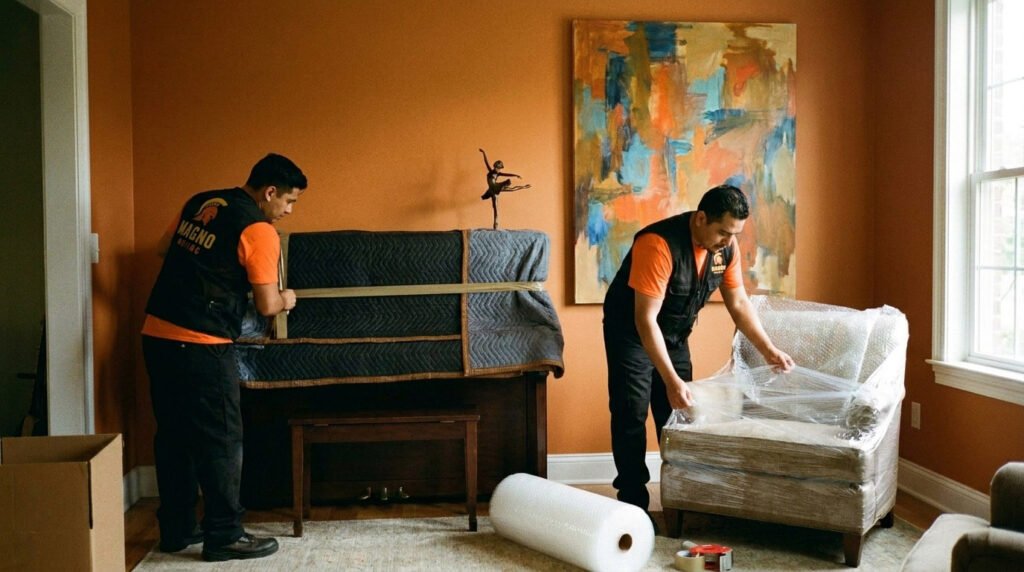
Some items can’t afford to be treated like boxes. They require a different level of care — and a different approach from the first step.
Most moving decisions are straightforward: wrap it, box it, load it. But a few items break that formula completely. A grand piano that’s been in the family for generations. An antique armoire that can’t be disassembled without damaging the joinery. A large sculpture, a grandfather clock, a fragile marble-top console. These pieces require specific handling, specific equipment, and a team that knows the difference between «careful» and genuinely skilled.
This guide covers what makes high-value item moves different, how to prepare for them, and what to expect from a professional team that takes this kind of work seriously.
The challenge with pianos, antiques, and high-value pieces isn’t just their value — it’s the combination of weight, fragility, irreplaceability, and often unusual dimensions. A standard moving approach — dollies, blankets, and careful loading — is necessary but not sufficient.
Before any high-value item is moved, photograph it thoroughly from every angle — including close-ups of any existing scratches, chips, or wear. This documentation protects both you and the moving team, and creates a clear baseline if any damage claim arises afterward.
For antiques and artwork, it’s worth knowing the approximate value and any specific vulnerabilities before the move. Is the finish original and irreplaceable? Are there fragile inlays or applied decorations? Does the piece have a documented provenance that affects its handling? Share this with the team when booking — not on the day of the move.
For upright pianos, the lid, key cover, and fallboard (the cover over the keys) should be secured closed before moving. For grand pianos, the legs are removed, the pedal lyre is detached, and the lid is closed and secured. The piano is then padded and placed on a specialized piano board for transport. This preparation happens before the piano is loaded — not during.
The pendulum and weights of a grandfather clock must be removed and packed separately before the clock is moved. Moving a clock with the pendulum in place will damage the mechanism. This is a simple step that prevents a repair that can cost more than the move itself.
Moving a piano safely requires a piano board (a heavy-duty dolly with straps designed specifically for pianos), piano skid boards for stairs, and enough team members to manage the weight — typically three to four people for an upright, and a larger team for a grand. Standard furniture dollies are not adequate and using them risks both the piano and the people moving it.
High-value items require more wrapping than standard furniture. Multiple layers of moving blankets, custom padding for protruding elements, and corner protection for fragile edges are standard practice. For antiques with delicate finishes, the blankets should be secured without using tape directly on the surface — tape adhesive can damage certain finishes.
Before moving a high-value item, the team should walk the entire route — from its current position to the truck — and identify every potential obstacle: tight doorways, sharp turns, low clearances, uneven thresholds. A piano doesn’t negotiate a tight corner the same way a sofa does. Planning the route in advance prevents improvised decisions under load.
Pianos and certain antiques are sensitive to temperature and humidity changes. Avoid placing them near exterior walls, heating vents, air conditioning units, or in direct sunlight. In New England, dramatic seasonal temperature changes can affect wood and felt over time — consistent climate control matters.
Even a perfectly executed piano move results in the instrument going out of tune — this is normal and expected. Plan for a professional tuning 2–4 weeks after the move, once the piano has had time to settle in its new environment. Don’t tune it immediately after arrival.
Once the item is in its final position, inspect it against the pre-move photos. Any new damage should be documented immediately, before the team leaves. This is the right moment for any claims or conversations — not days later.
Every high-value item move is different. Weight, dimensions, fragility, and route conditions all affect the time, equipment, and team size required. We recommend getting a quote that specifically addresses the piece — not a generic estimate.
At Magno Moving, we handle every item as if it’s irreplaceable — because some of them are. Whether it’s a family piano, a cherished antique, or a piece of art that matters to you, we bring the preparation, the equipment, and the care that the job demands.