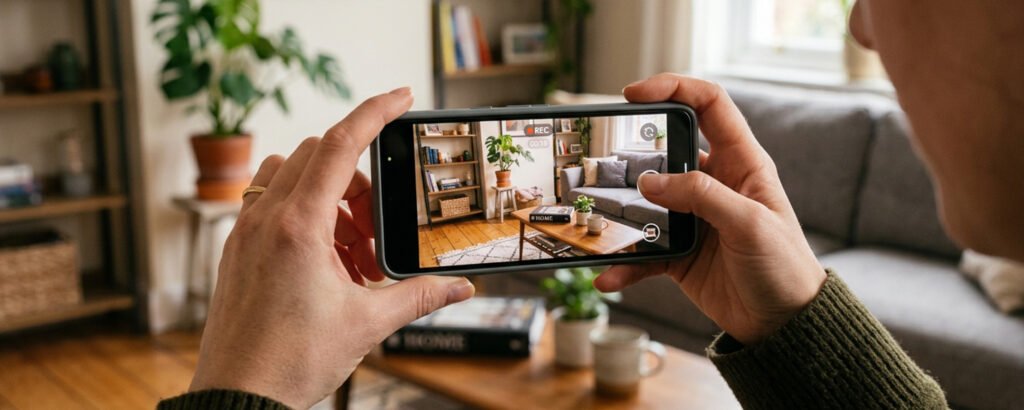
When you contact a moving company without images — or with unclear ones — the estimate you get back is approximate at best. The team has to calculate without seeing the actual size of your furniture, the access conditions, or the tricky spots in your space. The result: a price that may change on moving day because reality didn’t match what was assumed.
The fix is simple: a few well-done shots, taken in under 10 minutes, that give the company everything it needs to provide a real estimate. This guide shows you exactly what to record and how to do it.
A good quote depends on three variables: the volume of what’s being moved, how long the job will take, and the conditions of the space. The first two you can communicate in words — but the third, the actual access conditions, almost always needs images.
With clear photos and video, the company can:
Record the main furniture pieces from angles that show their real size: sofas, tables, chairs, shelving units, and TVs. If you have a sectional sofa or a large dining table, show it next to the exit door so it’s clear whether it fits through without disassembly.
Show the mattress (with its size visible), the bed frame, full wardrobes or closets, and any standalone drawers or modular units. If there are children’s beds with bunk or trundle structures, record those in detail.
Focus on the appliances being moved: refrigerator, washer, dryer, built-in microwave. Show whether they’re connected or disconnected, and whether there’s room to maneuver around them.
Desks, office chairs, bookshelves, and electronics. If there are large monitors or desktop setups, record them in detail.
These are the most underestimated spaces. Record everything that’s there, even if it doesn’t seem like much — stacked boxes, tools, luggage, sports equipment. It all adds volume and time.
The contents of the apartment matter, but access conditions are what most impact the time — and that’s exactly what gets underestimated most when quoting without images.
Record the entrance door from both inside and outside, showing its width. Walk with the camera from the door to the elevator or stairs so the distance and hallway conditions are visible.
If the building has stairs, record a full flight showing the width, step height, and whether there are turns or landings. This is key for estimating the additional time per floor.
Show the inside of the elevator: width, depth, and height. Some elevators look large but won’t fit a double mattress or a three-seat sofa. Knowing this in advance prevents surprises.
Record from where the truck would park to the building entrance. If there are visible restrictions — signs, bollards, controlled access — include those in the video.
Photos and videos work best when paired with a few basic details:
With the images and this information, the company has everything it needs to give you an accurate estimate — no back-and-forth, no last-minute questions, and no adjustments on moving day.
You don’t need video production experience or the latest smartphone. You just need to walk through your space calmly, record what’s there, and show how it’s accessed. With that, the company can calculate the real time, the team size needed, and give you a price that holds.
Every move is different. The estimate depends on volume, access conditions, and the date of service. We recommend quoting with photos and video for the most accurate price possible.
Ready to get a precise quote? Share your photos or video with the Magno Moving team and get a detailed estimate with no surprises.